
Driving Better Load Recommendations for Truckers

To comply with my non-disclosure agreements, I have omitted and anonymized confidential information. This case study is shared under fair use to demonstrate my research process, thinking, and impact.
DAT Freight and Analytics
DAT One
Usability Testing, Generative Interviews
3 months
The Problem
DAT One is a platform that works like Tinder for truckers: we offer truckers the ability to search for freight that works best for your needs. However, our platform has over 1 million loads posted daily. The process of finding what you are looking for is quite time-consuming, even with filters. Users have previously indicated that this is a pain point with using our product.
DAT product managers and designers proposed a new tool to alleviate some of this frustration: use an algorithm and past search history to generate personalized load recommendations for truckers. They requested my help with evaluating an early prototype of this feature as well as the algorithm that would recommend loads to users.

Early recommended loads prototype: iPhone widget
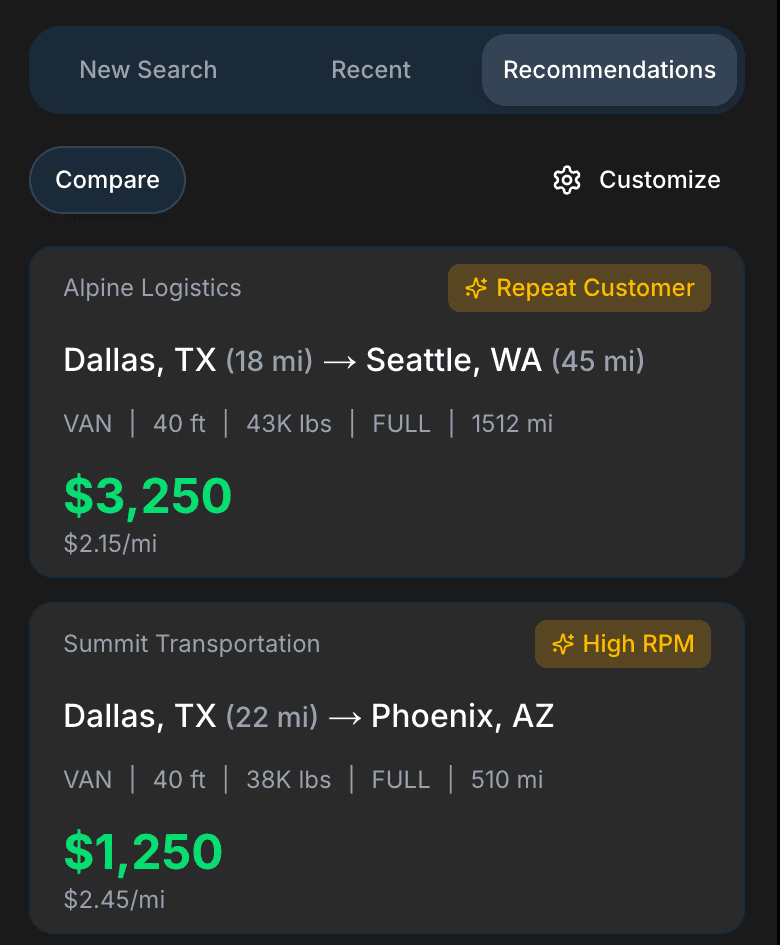
Early recommended loads prototype: DAT One app
Research
This problem called for two research studies:
First, we conducted a usability test on the early mobile prototype with 5 truckers from small, medium, and large businesses. We hoped to assess whether the recommended loads section was well-integrated into the existing DAT One app and ensure that the truckers were able to complete key tasks within the prototype. The tasks users completed were:
1. Viewing more details about a recommended load displayed in an iPhone widget.
2. Placing a (fake) call to book the recommended load from the app.
3. Finding the entire list of recommended loads in the app.
4. Customizing their recommended loads preferences via settings.
Second, we needed to assess the algorithm's ability to recommend the most optimal loads for truckers based on their search history within DAT. To do this, we recruited 10 truckers from small, medium, and large businesses who were willing to let us use their search history for research purposes. We then asked the algorithm to generate around 20 ideal loads for each user. We also sprinkled in 20 loads that were of bad quality (i.e., paid poorly, bad location) and 20 loads that were neutral as a control condition. We presented these loads more or less as a spreadsheet so participants would only evaluate the quality of the recommendations, not design/appearence. Users went through each load, and indicated whether or not they would call on it. Afterwards, I asked them follow-up questions about how they made their decision.








Results
Recommended loads is one of the most successful features DAT has launched this year, and it would not have been possible without the insights we learned during our UX research tests:
The usability test was overall a success: all participants indicated that they would love to use the recommended loads feature, and that if it worked as intended it would save them enormous amounts of time finding business. Furthermore, users were able to successfully complete all of the tasks without issues. We learned that our participants did not prefer to use iPhone widgets, so we removed it and focused on developing the in-app flows only.
The algorithm test led to several adjustments to how recommendations are made in an effort to better reflect truckers' priorities. For example, we hypothesized that deadhead (miles between a truckers' location and the loads' pickup address) would be an important factor. Even so, we underestimated just how critical it would be; during our test we observed many users forgoing "recommended loads" with great profits because the deadhead was too much. The development team adjusted the weight and parameters of deadhead miles accordingly. We made adjustments related several other factors in the same way, ensuring the algorithm gave users the best recommendations possible.
The launch of this product in June of 2026 was a unilateral success. Within 2 weeks it had gained 11,000 users, a number that is continuing to climb as of September 2026. Recommended loads is considered one of the best feature launches this year not only because of its overwhelmingly positive reception, but because the development timeline took 6 months from ideation to launch.
11,000
Users on launch
4.7/5.0
User satisfaction ratings
6
Months from ideation to launch

An example summary slide from algorithm testing, detailing user priorities for the algorithm